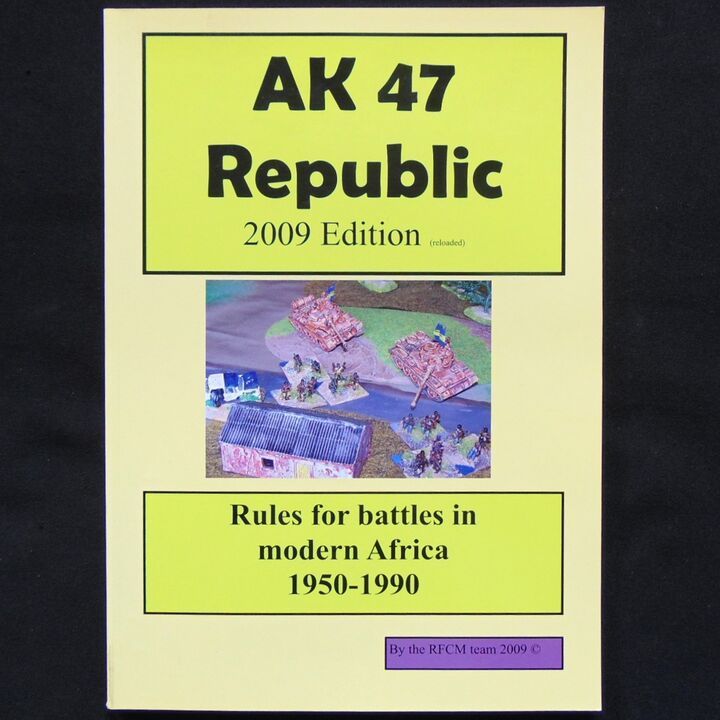
Peter Pig - AK 47 Republic 2009 Edition (Reloaded), Rules for Battles in Modern Africa 1950-1990
Condition: As New
Format: A4 softback book
Description (from Peter Pig Website):
Publication date: 2009 - Now only available as a PDF download
Period of Warfare covered: Peter Pig games always cover a narrow period in order to capture that period. Thus, the most important aspects of that war can be modelled and the less important ones piled into the general mechanisms. Africa 1950 to 1990.
Game setting: The figure scale is 1 to 1. Each player has an army chosen from the 20 listed in the rule book.
Game scenario generator: Peter Pig games are never two equal sides "bashing it out". Yes. Each player has an event table specific to his army choice (from the 20 in the rule book). Players carry out 15 opposed D6 rolls. The winner of each roll will consult his event chart and see what has happened. Each event chart is tailored to that army. The event chart are downloadable for free from the PP website. AK uses an asset system similar to the Square Bashing one. An army gets allowances for assets which it can roll for. Some armies are not allowed certain assets.
Game table size: Peter pig games should fit on a normal living room table.
How much scenery needed?: Peter Pig games use templates to represent scenery areas. The trees and houses are indicative not literal. Each player brings 7 pieces of scenery (size=8x6").
How many D6 needed:
Peter games allow a bunch of D6 to be rolled in order to bell curve the
outcomes. Results groups around the norm but extremes are possible
.
Measurement method: Inches.
Basing convention:
Peter Pig rules use 3x3 cm bases for most troop types. this size is tactile. has the same frontage when turned and allows figure formations to have depth as well as width.
3x3 cm bases for 2,3 or 4 figures. vehicles are un-
Typical army composition: Most PP games use about 100 figures a side. enough for PP to make some big sales and not too many to paint. Always 5 units . This stops players making a super unit (the Yamato syndrome).
Number of army composition lists included: Narrow period focus allows "in war" diversity to be modelled.
Unit motivation mechanism: There must be a reason for the general to be where he is. His presence should make a difference.
Moving mechanism: Something simple that can be memorised. PP rules give a move distance worth having.
Shooting mechanism: Shooting takes into account amount , skill and modifiers but ends up with a bunch of D6. Saving roll gets both players engaged. Shooter rolls 2D6. target rolls 1D6. The d ifference is the initial outcome. Modifiers are applied. Result is miss, pin or kill. Each unit will not always shoot with all of its bases. Thus, a large militia unit of 13 bases might only get to shoot with 5. a small but professional unit might get all of its bases firing.
Fighting mechanism: PP fight mechanism only consider about 8 modifiers. But these are the important ones for that period. another reason for keeping the period span small. Opposed D6 rolls with modifiers. In close assault better quality troops tend to prevail. Militia like to shot from cover but will not stand up to better troops when the latter get close.
Morale mechanism: Usual mechanic is 4,5,6= fails. 1 fail is not too bad. 3 fails is usually "goodnight Vienna".
Game length: Most PP games last 6 turns. The games are always alternate move type but with interaction via saves, reaction and opportunity. 3 Hours. Countdown from 21. D6 deducted every turn.
Book keeping:
Usually a few numbers to write down at the beginning but nothing after that. Most games have a planning sheet available as a free download on the PP website.
None after pre-
Principal victory condition: The two sides usually have different criteria to win. Most victory conditions are awarded D6 multiples so their exact worth is not known until the game end. Capturing tactical objectives. Destroying enemy units. Don't let them survive.
Changes needed for 25mm gaming:
Not all PP rules can be played with all figure sizes. usually the rules are written for 15mm.
Some bigger sizes such as 20mm can use the same basing and measurement without any change needed. 25mm will be given a conversion factor. You would replace each 15mm base with a single 25mm figure. Then carry on as normal.
Best parts: Bits we like about the game - A brilliant reserve system whereby bases are drawn off every unit at the game start and put in a reserve box. These reserves will arrive with a unit as the game progresses. they do not have to re join their original unit but must join a unit of same quality. Thus you might have pinned down a unit of 5 militia bases only to find the opponent puts his militia reserves into that unit, increasing it to 7 bases. The fog of war! this makes players keep units alive so that they might be reinforced. You cannot reinforce a dead unit. Reinforcement units can arrive on any table edge. Professional in wheeled vehicles might turn up on the enemy base edge. Militia just might turn up on your own edge if there is a road too! The game includes water borne forces, airpower and technicals.