0

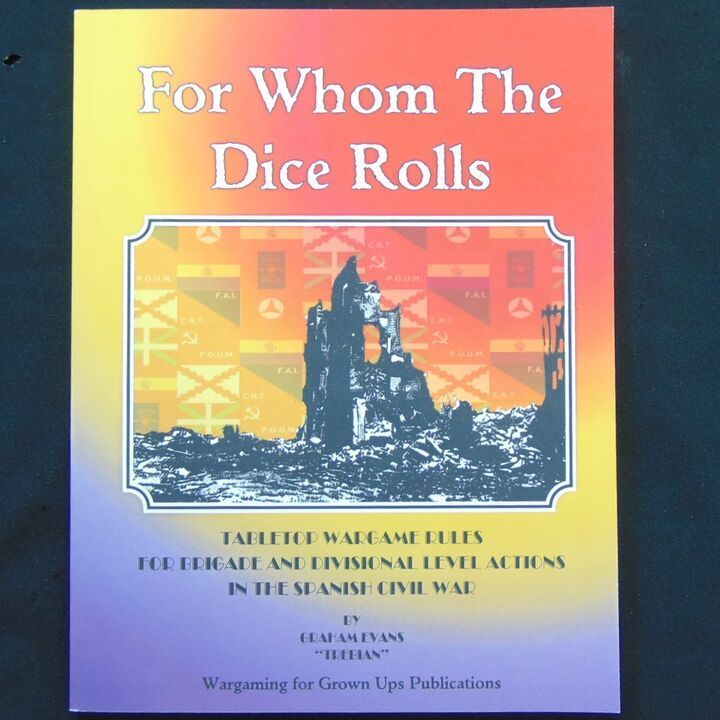
WFGUP - For Whom The Dice Rolls, Tabletop Wargames Rules for Brigade and Divisional Level Actions in the Spanish Civil War
£15.99
In stock: 1 available
Product Details
Brand: Wargaming for Grown Ups Publications

Classification: Wargames rules book, interwar, Spanish civil war, SCW

Condition: as new

Format: A4 soft back, 94 pages

Publication Date: 2020

Description : "For Whom The Dice Rolls" is a set of table top wargame rules for fighting Brigade-Divisional level actions in the Spanish Civil War. The rules were originally developed to cover the early mobile column warfare, with their colourful, mixed up units, commandeering any available truck to get them about, but they are suitable for the whole conflict.

Army Sizes and Figures
The rules were written for 15mm figures*, based on 30mm x 30mm bases, but anything similar will do. A standard infantry battalion consists of 4 companies of 2 bases and a command base. Normally one company will be a MG company. Each unit is therefore 18 small arms figures, 2 MGs and crew and a couple of command figures. 2-4 battalions make up a brigade or regiment, which may have further assets, such as heavy mortars or infantry guns. Brigades may be accompanied by artillery batteries ("Grupos") consisting of two bases of field guns or howitzers. If lucky an armoured company of 3 sections (each of one model) may be to hand. Aircraft and heavy artillery are handled by an off table mechanism, so it isn't necessary to have the models (although the author does).

A typical table top force for each army will therefore consist of 6-8 infantry battalions, plus one or two Grupos and maybe an armour section or two.

Troop Classifications
To simulate the wide range of forces present in the conflict, troops can be militia, paramilitaries or regulars. Within each category they can be Untrained, Trained or Experienced, and in addition they will be Reluctant, Committed or Fanatical. This enables the enthusiastic but woefully under prepared union militias to be modelled, as well as the trained, but rather-be-somewhere-else Italians. The combination of the two classifications gives a "Will To Combat" rating, that summarises the unit's morale state at the start of the battle. This solution was arrived at when it became clear that simply dividing troops into Raw, Average and Veteran/Elite was insufficient.

Style of Play
The system is an integrated IGO-UGO. Within each turn players activate units and perform a range of actions with them in any sequence they want, - firing before movement, or vice versa, reorganising to manage casualties or order a close assault. Players are limited to a maximum number of actions per unit per turn, and each "impulse" of action requires the playing of conventional playing cards of the correct suit, up to a maximum allowable by the efficiency of the army's command structure. This may be only 2 for a rag-tag bunch of squabbling militias (not recommended for the inexperienced or faint hearted), up to 6 for an integrated column of Foreign Legionnaires and their Moroccan auxiliaries.

The effective co-ordination of all arms, and the correct use of each weapon system is rewarded, but by no means easy to achieve, as tanks out run their support, or infantry become stranded as their armour doesn't quite make it

Airstrikes and corps level heavy artillery turn up when a joker is played, although exactly what you get and how much is randomised to some extent.

Combat Systems - Firing

Each small arms base rolls a number of dice depending upon the range, and this number is modified by factors relating to formation, cover and so on in a non-linear relationship. Hits are caused by rolling 6 or more, but the type of dice varies based on the training quality of the troops, with the worst rolling d6s and the best d10s.

Artillery bombardments work in a different way. Targets have the amount of fire at them recorded, but the outcome isn't known until the unit is activated or attacked. You may think you've shelled those militia into oblivion, but when your Bandera charges home, they may well all emerge from the cellars and ruins ready for action.

Armour combat includes close assaulting tanks with infantry armed with improvised weapons, and a step damage system that steadily degrades bases representing more than one vehicle, so not every hit destroys the target completely, but sometimes they do.

Combat Systems - Close Assault
The Close Assault system is similar in operation to other WGFGU rules, in that each round is a simple dice roll and calculation that always gives a clear outcome, with one side or the other forced to retreat with the losing side taking the greater casualties. Defenders in cover are forced back from position to position, and attackers have to weigh carefully the decision whether to press on, or consolidate on the position they have won.

Morale
Morale is embedded into the Close Assault and firing systems, together with specific "Terror Tests" if confronted with "modern" weapons like tanks or aircraft. Use is also made of what are known as "It Tolls For Thee" tests, which see whether or not a unit is broken due to the damage it has taken. Players must husband their troops carefully, making sure they reorganise and clear casualties on a regular basis to ensure units do not become overwhelmed with disorder and cease to function.

QRS
The rule book has the normal WGFGU QRS on the back cover, but due to the complexity of modern warfare there's a second page at the end of the rules as well. These two sheets should be all you need to play the game once you've had a read through of the rules.

Troop Organisations and Orbats
The rule book concludes with 16 pages of information to help you organise your figures. These cover:

  • Army of Africa
  • Corpo Truppo Voluntarie (CTV)
  • Euzko Gudarostea (Basque Army)
  • International Brigade
  • Nationalist Regular Army
  • Peninsula Army
  • Police
  • Political Party and Trade Union Forces and Militias
  • Republican People’s Army/Popular Army

Specific higher level organisation charts are given for:

  • CTV Littorio Division - March 1937
  • Legion Column - November 1936
  • Nationalist Brigade - Basque 1937
  • Nationalist Column - Early 1936
  • Nationalist Division - Late 1936 onwards
  • Republican Column - Early 1936
  • Republican Militia Column - 1936
  • Republican Mixed Brigade - Late 1936 onwards

14-day withdrawal period from delivery  
Save this product for later
Customer reviews
Reviews only from verified customers
No reviews yet. You can buy this product and be the first to leave a review.
Share this product with your friends
WFGUP - For Whom The Dice Rolls, Tabletop Wargames Rules for Brigade and Divisional Level Actions in the Spanish Civil War